Three Coney Island Dogs Finally Made the Chili Situation Make Sense
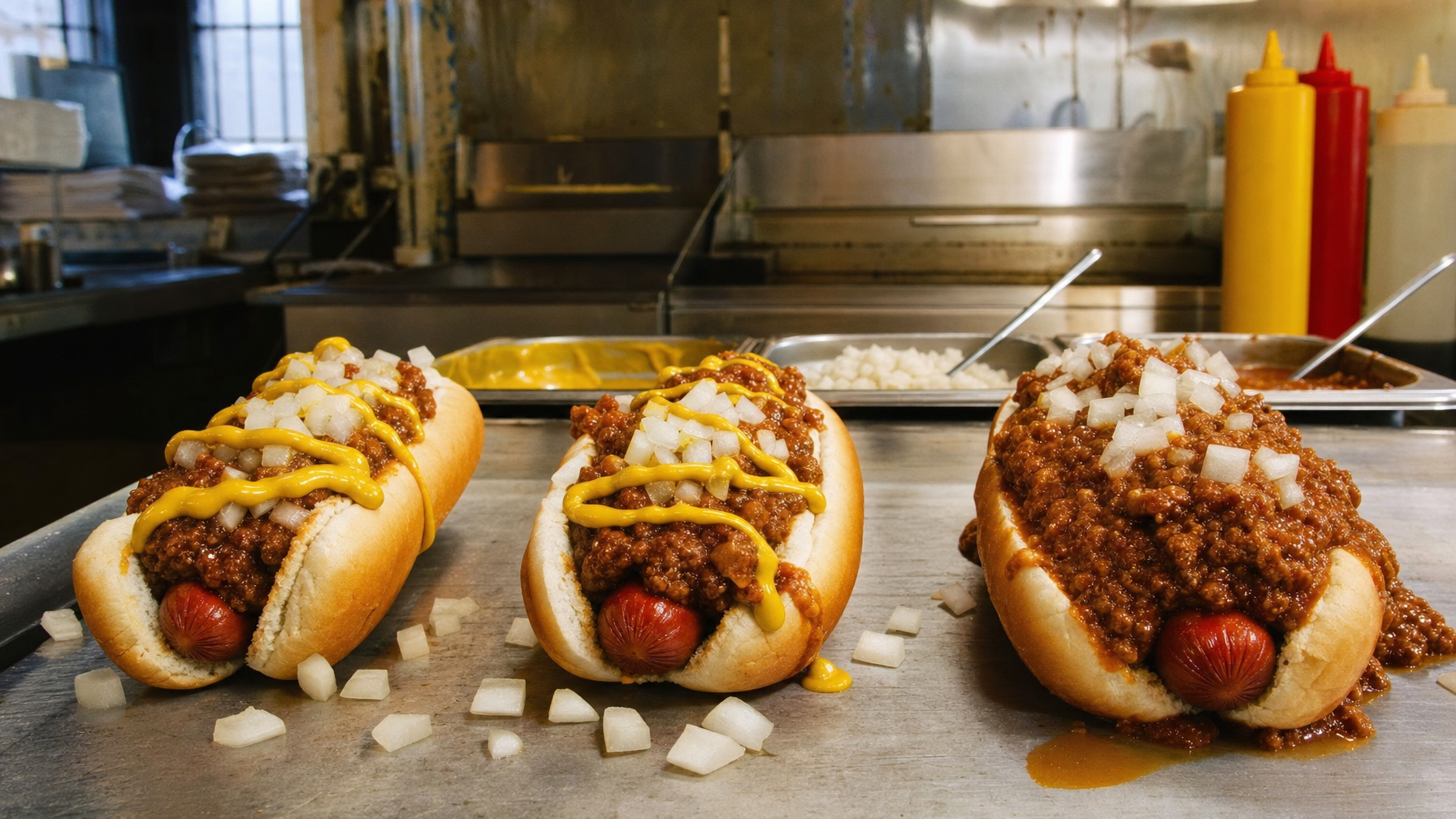
For hot-dog obsessives and food-culture readers trying to understand a Coney Island-style build, three dogs make the lesson obvious: chili should support the frank, not bury it. Put mustard, onions, chili, bun, and dog side by side in slightly different proportions and the argument stops being theoretical. Jason's standing position is no ketchup. This particular flavor court runs on mustard's tang, onion crunch, savory chili, and a hot dog that is still allowed to taste like itself.
Three Dogs Walk Into a Bowl of Chili
The experiment was not about declaring one sacred recipe for every Coney Island-style dog. Vendors and cooks have their own methods, and pretending there is one tiny clipboard-approved formula would be deeply unserious. This was a kitchen test of proportion, texture, and restraint.
Each dog kept the same basic cast: a cooked frank in a sturdy bun, mustard, chopped onions, and chili. The variable was the chili portion. One dog got buried, one got a sensible cap, and one got a restrained accent. The result was a useful reminder that toppings are not competing for a lead role. They are supposed to make the lead better.
Coney Island Is Not a Permission Slip for Chili Pudding
In practical terms, a Coney Island-style dog is commonly understood as a hot dog in a bun topped with chili, mustard, and onions. The details can vary from one vendor or home kitchen to another, including the seasoning, the texture of the chili, the onion cut, and the order of assembly. Familiar style conventions are not the same thing as a universal law.
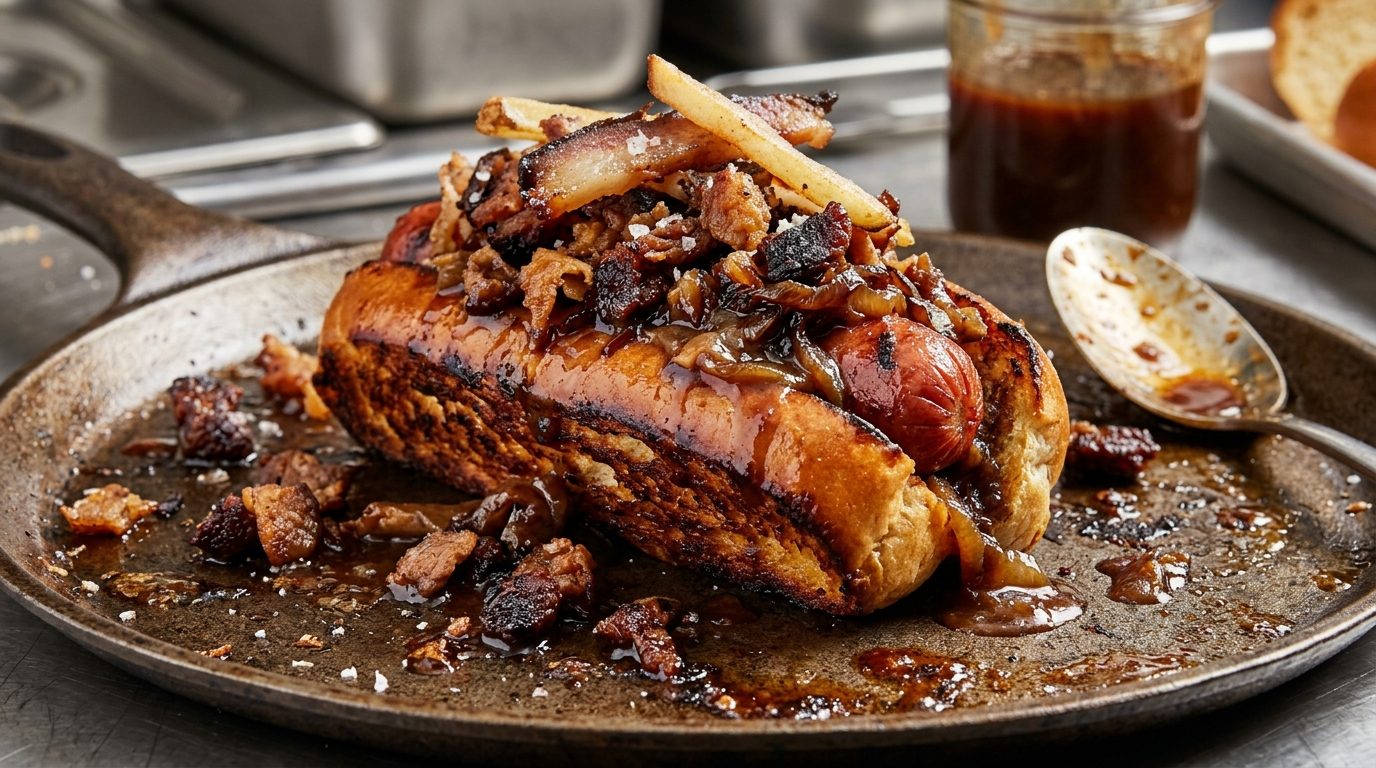
The recurring danger is simple: loose or excessive chili can saturate the bun, hide the frank, mute the mustard, and erase the onion's crunch. Then every bite becomes one soft, brown, bun-adjacent event. That is not a topping. That is a hostile takeover.
The three-dog comparison makes the boundary easier to spot. Chili earns its place when it adds savory depth and moisture while leaving room for the dog, bun, mustard, and onions to register separately.
Dog One: The Chili Blanket Test
Dog One received a deliberately generous layer of chili. It still had mustard, chopped onions, a cooked frank, and a bun chosen for enough structure to make a fair attempt at survival. But the chili was clearly in charge.
The first bite revealed the problem. The bun and chili arrived first, while the frank had to fight its way through. The onions offered occasional texture, but they were easy to lose in the soft topping. Mustard was present in principle and faint in practice.
This version established the excess end of the spectrum. A Coney dog should not become a bowl of chili wearing a bun as a hat. If the eater cannot identify the dog without sending in a search party, the build has gone too far.
Dog Two: The Sensible Chili Cap
Dog Two got a controlled cap of chili, enough to cover much of the frank without forming a second entrée on top of it. This is where the build started behaving like a team sport.
Texture did much of the work. The chili needed to be thick enough to stay where it was put, yet soft enough to settle into the bun and around the frank. A stiff paste is not charming. A watery runoff is worse. The useful middle ground clings without cementing the whole operation shut.
Here, mustard and onions became active ingredients instead of decorative confetti. Mustard's sharp tang cut through the rich chili. Chopped onions brought freshness and a clean crunch. The frank remained easy to taste. Compared with Dog One, this was the likely balance point: enough chili to announce itself, not enough to give a speech.
Dog Three: The Dog Gets a Speaking Role
Dog Three used chili as an accent. The frank had the clearest flavor presence, with a smaller amount of chili adding savoriness rather than mass. This was the most restrained version, and it made contrast easiest to notice.
The bite moved from bun softness to frank texture, then chili richness, mustard acidity, and onion crunch. That sequence matters. A good loaded dog is not one uniform texture with a vague memory of meat. It has contrast.
Bun condition and assembly order are texture controls, not fussy chef theater. A bun that is already soggy has surrendered before kickoff. Applying mustard where it will remain noticeable, adding the frank, using a stable portion of chili, and finishing with onions helps keep the bite intact. The goal is a stable dog, not a chili landslide.
Jason's personal preference landed closest to Dog Two, leaning toward Dog Three. In other words, let the chili be generous enough to matter and restrained enough to leave the frank its name on the marquee.
Mustard, Onions, and the No-Ketchup Treaty
Mustard is not there for yellow decoration. Its job is brightness and tang. It creates a direct counterpoint to rich chili and savory meat, keeping the build from settling into a low, heavy note.
Onions have an equally important job: freshness and crunch. They interrupt the softness of bun and chili, which is exactly what the bite needs. Tiny chopped pieces work well because they can spread across the dog rather than arriving as one giant onion boulder.
And ketchup? Not in Jason's version. The no-ketchup stance is firm, well established, and completely unsurprised by your disagreement. This build is designed around mustard, onions, chili, and the dog. That is a personal opinion, not a commandment carved into a stadium concession stand.
Chili Should Wear a Name Tag, Not a Disguise
The proportion lesson is almost insultingly simple: dog first, chili second, mustard and onions clearly present. No rigid scoop measurement can account for every frank size, bun shape, or chili texture. Visual and bite-based cues are more useful.
What a balanced Coney Island-style dog looks like
- The frank remains at least partly visible rather than disappearing under a mound.
- The chili sits on the dog instead of pooling in the bun.
- The bun looks supported, not saturated and slumped.
- Mustard and onions are visibly distributed across the build.
- The toppings stay put between bites with only ordinary, honorable mess.
What a balanced bite tastes and feels like
- Chili adds savory depth without masking the frank.
- Mustard cuts through the richness.
- Onions provide a distinct crisp contrast.
- The bun holds the components together without becoming paste.
- The hot dog remains identifiable as the central ingredient.
Quick repairs for a dog that has gone sideways
- Watery chili: Use less of it, or let it cool slightly until it is more cohesive before topping the dog.
- Too many toppings: Remove enough chili that the mustard, onions, and frank can reappear.
- Dry bun: A modest amount of chili can help, but do not try to rescue it with a flood.
- Onions disappearing into the sauce: Add some chopped onions at the end so their crunch stays audible.
The Final Plate Gets a Verdict, Not a Participation Trophy
Dog Two won the test. Its sensible chili cap gave the build richness and moisture without flattening every flavor and texture into one soft blur. Dog Three was excellent for anyone who wants the frank to dominate more clearly. Dog One made its case mainly by proving what not to do.
That is the useful part of making three versions side by side. An abstract topping argument becomes three immediately comparable bites. The best Coney Island-style dog is not the one with the most chili. It is the one where every component earns its space.
For more of Jason's ongoing hot-dog research, follow @jasonsgrub on Instagram.
FAQ: Five Questions Before You Add Another Ladle
Does a Coney Island-style dog always use chili, mustard, and onions?
Those are familiar components of the style, but recipes and vendor builds can vary. The focus here is not enforcing a universal formula. It is finding balance among chili, mustard, onions, bun, and frank.
How much chili should go on the dog?
Use enough to add flavor and moisture without hiding the frank or making the bun collapse. The three-dog test is more useful than a rigid universal number because chili thickness, bun size, and frank size all change the calculation.
Why leave out ketchup?
Jason's no-ketchup stance keeps this build centered on mustard, onions, chili, and the dog. It is a firm personal preference, not a rule for every hot-dog eater on Earth.
Should the chili be chunky or smooth?
Stability matters more than picking a side in the chunky-versus-smooth cage match. The chili should be cohesive enough to stay on the dog while still blending into the bite. It should not run everywhere, and it should not behave like paste.
What is the biggest mistake with this build?
Treating chili as the main event. When it overwhelms the dog, mustard, onions, and bun, the contrast disappears. A Coney Island-style dog should taste layered, not like a ladle made a unilateral decision.
Enjoyed this? There's more from Jason's Grub.
Follow on Instagram →