Valletta Zalzett Posts Are Putting Olive Oil on the Hot Dog Argument
Olive oil may belong in a particular zalzett preparation, but it cannot be treated as a defining Valletta rule unless a named Maltese source says so. This is for hot dog obsessives and food culture readers who want to separate a delicious personal riff from a caption wearing an authenticity costume.
- Zalzett is the Maltese word used for sausage, but recipes and presentations can vary.
- Olive oil could be part of cooking, bread preparation, or a finishing drizzle. Those are different claims.
- A Valletta location tag does not turn a homemade choice into a city standard.
- Without a named cook, restaurant, recipe, or source, a caption is not culinary evidence.
- Jason’s verdict is an opinion about eating, not an official ruling from Malta.
Is olive oil part of Valletta zalzett, or did the caption get carried away?
Olive oil is not established here as a defining feature of Valletta zalzett because no named Maltese source or identifiable post is attached to that claim. That does not make olive oil a bad idea. It means the claim needs to stay in its proper little bun.
Zalzett is a Maltese sausage, often discussed as a pork sausage in Maltese food writing and recipes. The important distinction is between what a source calls the sausage itself and what a cook does with it on a given day. A recipe can use olive oil in a pan. A sandwich can have olive oil brushed on bread. A finished plate can get a glossy drizzle. None of those choices automatically proves that olive oil belongs in the sausage mixture or defines every Maltese version.
Here is the clean way to sort the evidence:
| What you are looking at | What it can prove | What it cannot prove |
|---|---|---|
| Traditional description from a named Maltese source | How that source describes customary ingredients, cooking, or serving | That every cook in Malta follows one fixed recipe |
| Named recipe by an identifiable cook or publication | That cook’s stated method and ingredients | That the method is the only authentic version |
| Restaurant presentation with a named venue | What that venue serves | That the city has declared it the standard |
| Social post with a complete caption and source | What the poster says they made or ate | That a visible oil drizzle is traditional sausage evidence |
Jason’s taste verdict comes later, where it belongs. Taste can settle lunch. It cannot settle culinary history by yelling louder than the footnotes.
What do Maltese sources actually say about zalzett?
The responsible answer is that a source comparison requires named, checkable Maltese descriptions, and none is identified alongside the olive oil claim here. It would be make believe to invent quotations, ingredients, or a tidy Valletta doctrine just to make the table look handsome.
A solid comparison should record the precise wording used by each source. Look for whether it identifies the meat, seasoning, casing, cooking method, accompaniment, and any claimed connection to a particular Maltese town or market. If olive oil appears, the key question is where it appears: inside the sausage, in the pan, on bread, or on the finished serving.
| Source | Description to verify | Olive oil reference | Tradition or personal variation? |
|---|---|---|---|
| Named Maltese cookbook, food publication, cultural organization, or recipe writer | Exact ingredients and stated preparation | Record only explicit wording | Use the source’s own label |
| Named Valletta restaurant or market vendor | What is served and how it is described | Record only menu or recipe detail | Restaurant presentation unless a source supports a broader claim |
| Identifiable social post | Visible preparation and full caption | Describe oil only if clearly shown or stated | Personal preparation unless independently supported |
Disagreement would not be a scandal. Sausage traditions are gloriously untidy. The problem starts when one modern recipe, one restaurant plate, or one glossy clip gets promoted to the only proper version without evidence.
Valletta in the caption does not automatically make the recipe Valletta style
No, a post made or photographed in Valletta does not by itself prove that its preparation is a Valletta standard. It proves that Valletta was involved in the scenery, which is lovely but not the same thing as documentation.
Before treating a caption as evidence, check whether it names a real cook, restaurant, market stall, cookbook, or recipe source. Then check whether the post gives a complete ingredient list and says what exactly is being called traditional, authentic, or original. Those words can be useful when they point to a source. On their own, they are seasoning.
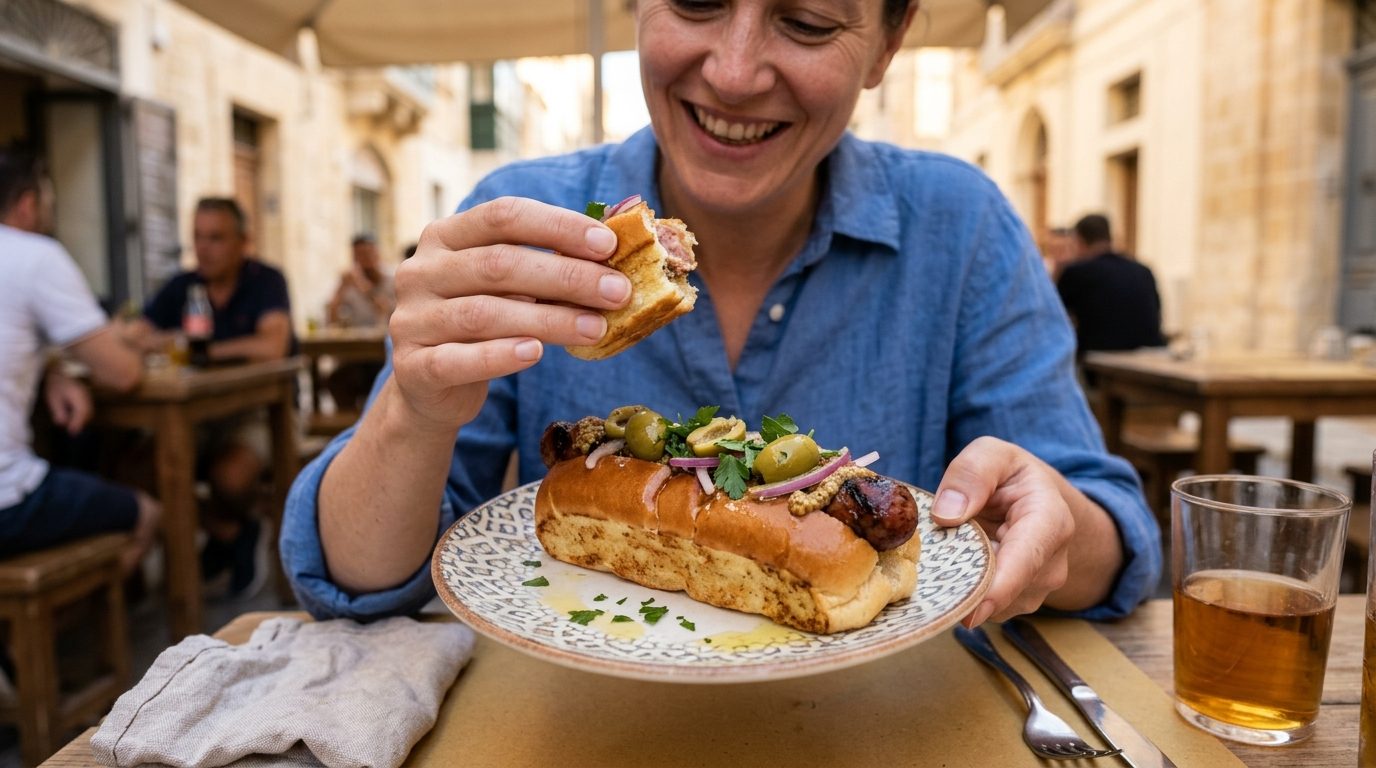
A careful reader can describe what is visible. If a photo clearly shows a sausage in bread with a sheen of oil, say that. Do not leap from shine to a claim about the sausage mixture, local custom, or centuries of Valletta kitchen law. Olive oil has many talents. Telepathy is not one of them.
The olive oil argument is really several arguments wearing one apron
People may be arguing about different uses of olive oil, so the first job is to separate the questions before declaring a winner. Calling all of them simply “olive oil in zalzett” makes the discussion mushy.
- Oil in the sausage mixture: This is an ingredient claim. It needs recipe evidence.
- Oil used for cooking: This is a technique claim. It may reflect a cook’s preference, equipment, or the need to prevent sticking.
- Oil brushed on bread: This is a sandwich construction choice. It affects texture and richness more than sausage identity.
- Oil drizzled at the end: This is a finishing move. It may add aroma and gloss, or it may turn a good sausage into a slippery little opera.
A visible drizzle cannot establish what went into the sausage. Likewise, a recipe that fries sausage in oil cannot establish that oil belongs in every traditional mixture. Keep each claim in its lane and nobody has to throw a condiment bottle.
What counts as a misleading zalzett post?
A zalzett post becomes misleading when it presents an unverified variation as the only traditional version, assigns a place without evidence, or quietly relabels a substitution as an original ingredient. Creative cooking is not the villain. Pretending that creativity arrived on stone tablets is.
Caption trouble worth noticing
- “Authentic Valletta zalzett” with no named venue, cook, recipe, or source.
- “Traditional olive oil sausage” when the image only shows oil on the finished bread.
- “Original recipe” without an ingredient list or explanation of where the recipe came from.
- A recipe that changes a key ingredient but calls the changed ingredient traditional without support.
How to check without becoming a culinary detective in a trench coat
- Find the named cook, business, publication, or recipe writer.
- Read the full ingredients and method, not only the caption headline.
- Identify whether olive oil is in the mixture, pan, bread, or final drizzle.
- Compare the claim with independent Maltese descriptions that can be checked.
- Call a variation a variation when the evidence does not support a broader tradition claim.
That is not snobbery. It is just refusing to let one confident sentence turn into culinary folklore before lunch.
Jason’s verdict: olive oil gets a hearing, not a coronation
Jason’s opinion is that olive oil can be excellent around zalzett, but it should support the sausage rather than turn the whole situation into a grease portrait. A restrained brush on good bread can add fragrance and soften a crusty edge. A small finish can work when the sausage is lean or the toppings need a fruity lift.
Jason would seek out a plainly described sausage first, ideally one where the seasoning and snap get the spotlight. He would tolerate olive oil as a stated cooking choice or a light finishing move. He would pass on a heavy flood that mutes the sausage, wrecks the bun, and exists mainly because a glossy caption needed a plot twist.
And ketchup remains out. This is Jason’s opinion, not a Maltese culinary ruling. Ketchup is not being arrested. It is simply not getting a guest pass.
Try this before declaring culinary war
Compare methods only when you can verify the ingredients and preparation for both versions. Make or order a source-based preparation when an identifiable Maltese recipe is available, then compare it with an olive oil version that clearly states whether the oil is used in the pan, on the bread, or at the finish.
Hot dog argument homework: Write down what the oil actually does to the bite. Does it sharpen aroma, improve the bread, soften the sausage flavor, or merely make your fingers look expensive? Follow @jasonsgrub on Instagram for more hot dog arguments, place finds, recipes, and product discoveries.
Frequently asked questions about Valletta zalzett and olive oil
These answers separate what can be established from what remains a personal cooking choice. That is less dramatic than a food fight, but considerably more useful.
What is zalzett?
Zalzett is the Maltese word used for sausage. Specific recipes can differ in meat, seasoning, cooking method, and serving style, so a precise description should name the source that supplied it.
Is olive oil traditional in zalzett?
Olive oil should not be called traditional in the sausage mixture, cooking method, or serving style without a named Maltese source that explicitly says so. An olive oil recipe can still be tasty. It should simply be labeled as that cook’s version unless evidence supports a broader claim.
Does a Valletta post prove that a preparation is authentic?
No. A Valletta tag establishes location at most. A broader authenticity claim needs an identifiable cook or business, clear ingredients and method, and support from independent Maltese descriptions.
Can I substitute olive oil in a zalzett recipe?
Only the recipe itself can tell you whether it permits that change. If you replace another fat with olive oil, call it a substitution and judge the result on flavor, browning, and texture rather than calling it traditional by default.
What should I look for in a reliable zalzett post?
Look for a named cook or business, a complete ingredient list, specific preparation details, a stated source for traditional claims, and agreement with independent Maltese material. A handsome closeup is welcome. It is not a citation.
Sources
These links are reliable starting points for checking Maltese culinary context and official food naming records, but they should not be treated as proof of an olive oil claim unless the linked material explicitly addresses zalzett.
- VisitMalta, the official tourism site for Malta.
- University of Malta Library, a starting point for locating Maltese books, periodicals, and archival food writing.
- European Commission eAmbrosia register, the official register for protected food and drink names in the European Union.
Enjoyed this? There's more from Jason's Grub.
Follow on Instagram →