Part of the Recipes and Cooking Methods hub
Penang’s Ramly Dog Problem: Is the Egg Wrap Still Street Food When the Internet Copies It?

An egg wrapped hot dog can still have street food spirit, but it is not automatically a Ramly Burger just because somebody performed a dramatic griddle fold. This is for hot dog obsessives and food culture readers who want the Malaysian influence named properly, then want to know whether the bite is actually worth the napkins.
- An egg wrap can be an adaptation rather than an authenticity costume.
- Malaysian burger stall cooking, including egg wrapped assembly, deserves specific credit when it is the inspiration.
- A Ramly Burger name carries brand and cultural context that a random hot dog copy does not inherit by osmosis.
- The final judge is texture: browned egg, savory sausage, soft bun, useful sauce, and no floppy disaster.
Penang makes this a deliciously awkward question
Yes, the wrap can remain street food in spirit, but it should not be passed off as an original Ramly creation when it is simply a hot dog borrowing a recognizable Malaysian griddle move. Penang is the setting for the argument, not a magic stamp that turns every folded egg on the internet into a local tradition.
Internet food loves a visible trick. Egg hits griddle, filling lands in the middle, corners fold in, camera gets its little dopamine pellet. Food culture has a longer memory than a camera roll, though. A tidy egg blanket is not a passport, but it can still be a very good lunch.
That distinction matters most in a place like Penang, where street eating is not decorative wallpaper for a food video. George Town, Penang is recognized by UNESCO for its historic urban landscape and living cultural heritage. That does not prove that this particular hot dog is Penang food. It does mean the place deserves more respect than a vague location tag and a slow motion sauce squeeze.
What the Ramly reference actually brings to the griddle
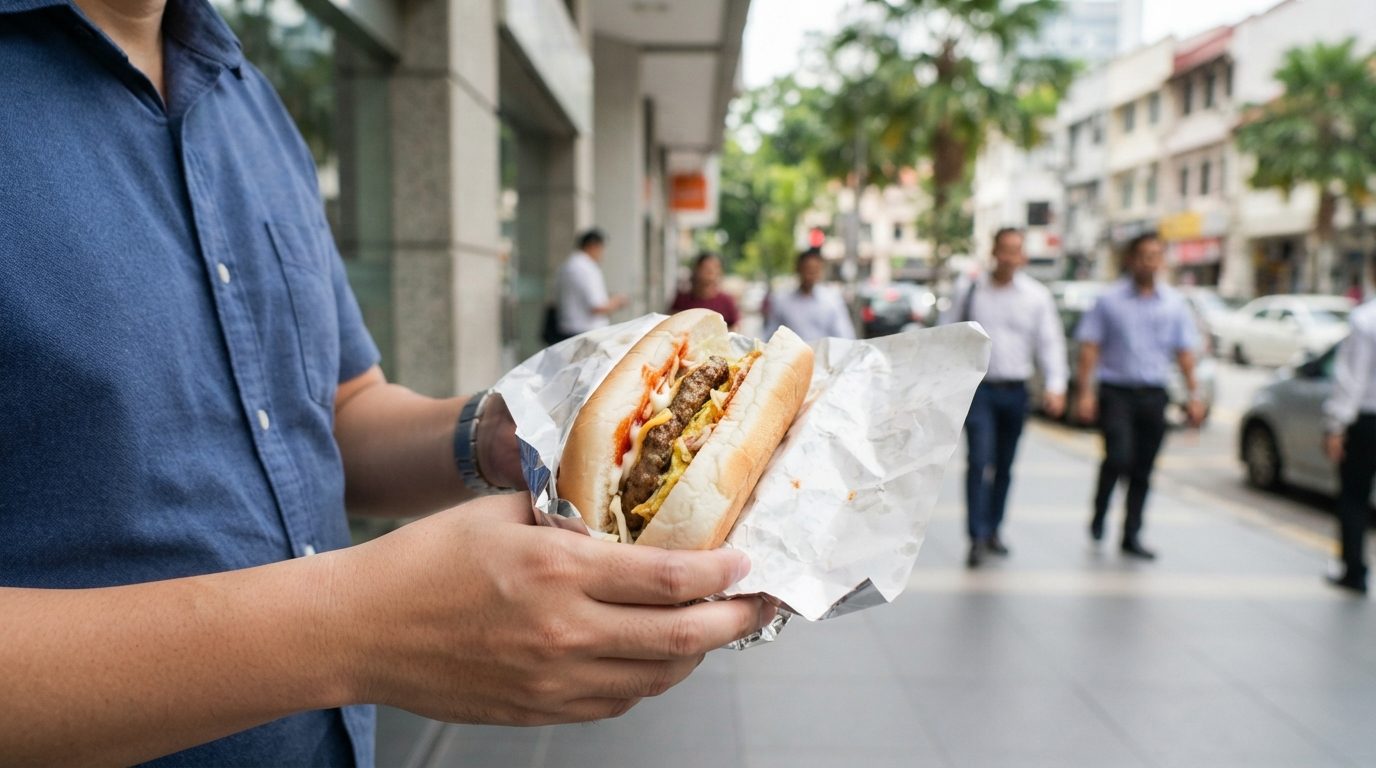
The Ramly reference brings a Malaysian burger context, a fast griddle style, and an egg wrapped presentation that should not be confused with a generic omelet around a sausage. Ramly Food Processing is a Malaysian company with burger and sausage products, while Malaysian burger stalls have made egg wrapped burger assembly recognizable well beyond any single home kitchen.
There are three different things that tend to get tossed into one greasy little pile:
- A Ramly Burger: a burger connected to Ramly branding, products, or a clearly identified seller using that context.
- A Malaysian style egg wrapped burger: a descriptive phrase for a burger format that acknowledges the broader cooking influence without claiming every version is the same product.
- An egg wrapped hot dog inspired by that format: a new adaptation that changes the filling and should say so plainly.
The company name is not a synonym for every burger wrapped in egg. Likewise, the technique is not ownerless just because it looks excellent on a griddle. A good caption can hold both thoughts at once: inspired by Malaysian egg wrapped burger cooking, adapted here with a hot dog.
Calling it fusion does not pay the credit bill
No, calling a dish fusion does not explain who developed or made a technique recognizable. Fusion can describe the result, but it is often used like a tiny linguistic tarp thrown over a much larger question.
Credit has levels. First, name the Malaysian influence when the egg wrap and griddle assembly are the clear reference. Second, name Ramly only when the brand, product, or a verifiable Ramly seller is genuinely involved. Third, do not market a copied format as though it drifted down from the heavens and landed directly in your cast iron pan.
Recipe captions, menus, and video narration are where this goes right or wrong. “Egg wrapped hot dog inspired by Malaysian burger stall cooking” is specific, useful, and honest. “My original egg dog invention” is the culinary equivalent of putting a fake mustache on somebody else’s bicycle.
Inspiration is not ownership. Attribution is not a ceremonial bow before getting back to business. It is the plain statement that lets people trace a dish backward instead of pretending food history began when a phone pointed at a skillet.
Can the hot dog earn its egg jacket?
Only if the egg adds flavor and structure instead of sitting around the sausage like a loose yellow scarf. The wrap has a job: bring browned edges, savory richness, and a little grip to the bite.
The bite test
A convincing version should have crisp or lightly browned egg edges, a fully set center, a sausage with some snap, and enough sauce to connect the bun and filling without turning the whole affair into a slippery hostage situation. The bun should support the wrap, not compress it into egg confetti.
A thin egg layer gives you a close fitting wrap and lets the sausage remain the headline. A thicker omelet style layer makes the egg more dominant, which can be pleasant, but it risks turning a hot dog into a breakfast sandwich wearing an identity crisis. Neither is automatically wrong. The question is whether the proportions make sense after the first bite.
If the egg is rubbery, the cultural conversation cannot rescue lunch. If the egg is browned, the sausage is hot, the sauce is balanced, and the bun holds steady, the adaptation has earned a seat at the griddle.
Build an adaptation, not a fake passport
A fair internet version is easy to make honestly: call it an adaptation, credit the Malaysian inspiration, and do not call it an authentic Ramly Burger. This is an editorial cooking approach, not a claim to reproduce a particular stall or company product.
- Heat a griddle or broad skillet until it is hot enough to cook egg quickly.
- Cook a hot dog until heated through and lightly browned if that is your preference.
- Pour a beaten egg into a thin layer on the cooking surface.
- Set the hot dog on the egg while it is still soft, then fold the egg around it as the edges set.
- Add sauces sparingly, place the wrapped dog in a bun if that is the format you want, and eat it immediately.
Three versions that should not wear the same name tag
| Version | What it is | Honest name |
|---|---|---|
| Malaysian egg wrapped burger format | A burger preparation associated with Malaysian stall cooking and its own local context. | Use specific brand or seller language only when verified. |
| Penang inspired egg wrapped hot dog | A hot dog adaptation that acknowledges Penang as the cultural setting for this discussion, not its proven birthplace. | Egg wrapped hot dog inspired by Malaysian burger cooking. |
| Generic social media copy | A dramatic fold with no source or context named. | Egg wrapped hot dog, if no influence is being claimed. |
Sauce is where restraint becomes a public service. Choose a savory sauce that complements the sausage and egg, then use enough to season the bite. The point is not to build a sauce aquarium inside a bun.
When does a borrowed street food move become its own dish?
A copy becomes its own dish when it is openly adapted, clearly credited, and judged by what it contributes rather than marketed as an untouched original. Changing a burger patty to a hot dog does create a different eating experience. It does not erase the source technique.
Use three tests before naming the thing
- Attribution: Does the description name the Malaysian egg wrapped burger influence when that is plainly the source?
- Transformation: Has the new filling, sauce, bun, or method created a meaningfully different bite?
- Honesty: Would the name still make sense if the reader knew exactly what happened on the griddle?
This avoids two lazy extremes. One says every adaptation is theft. The other says every borrowed technique becomes anonymous the moment it gets edited into a short video. Food is better, and more interesting, than both of those takes.
Call this a Penang inspired egg wrapped hot dog if Penang is the lens and Malaysian burger cooking is named as the influence. Do not call it a Ramly Burger unless the evidence truly supports that label.
The verdict: street food survives the copy, but credit should come along
Yes, an egg wrapped hot dog can still function as street food because it is fast, griddle cooked, portable, and best eaten immediately. Its identity, however, depends on truthful naming and a bite that delivers more than a photo opportunity.
Street food is not preserved in amber. Cooks adapt formats, swap proteins, change sauces, and make lunch answer to whatever is sizzling nearby. The honest move is to say what inspired the dish and then let the finished thing stand on its own browned edges.
My verdict is blissfully simple: the egg wrap is not the problem. Pretending nobody showed you how to fold it is.
Try the griddle test: Make the egg wrapped hot dog as an adaptation. Name the Malaysian inspiration. Then judge it by the snap, the browned egg, the sauce balance, and whether the first bite stays together like it has something to prove.
Follow @jasonsgrub on Instagram for more hot dog places, recipes, products, and food culture stories.
FAQ: the questions still sizzling at the edge of the griddle
Is an egg wrapped hot dog a Ramly Burger?
No, not automatically. A Ramly Burger has a specific Malaysian brand and burger context. A hot dog using a similar egg wrapped assembly is better described as an inspired variation unless it is verifiably connected to Ramly products or a Ramly seller.
What makes the egg wrap recognizable?
The recognizable feature is egg cooked on a hot griddle and folded around the filling during assembly. Different cooks may handle the egg, sauces, and fillings differently, so one internet clip should not be treated as the single official version.
Does swapping the patty for a hot dog erase the Malaysian influence?
No. The protein changes, but the borrowed assembly idea remains relevant. Naming that influence is more useful than pretending the substitution wiped the slate clean.
Is Penang the birthplace of the Ramly Burger?
This article does not make that claim. Penang is the setting for a food culture question, not an unsupported origin story for a burger format.
Can I call my home version street food?
Call it street food inspired if it is cooked quickly, served for immediate eating, and described honestly. A home or internet recreation should not imply that it is an established Penang tradition without evidence.
Sources
These sources provide background on Ramly, Malaysia, and George Town. They do not settle the flavor verdict, because thankfully no committee has been given that much power.
 Follow on Instagram
Enjoyed this? There's more from Jason's Grub.
Follow on Instagram →