I Put Costco’s Lost Polish Dog on Trial in My Own Memory
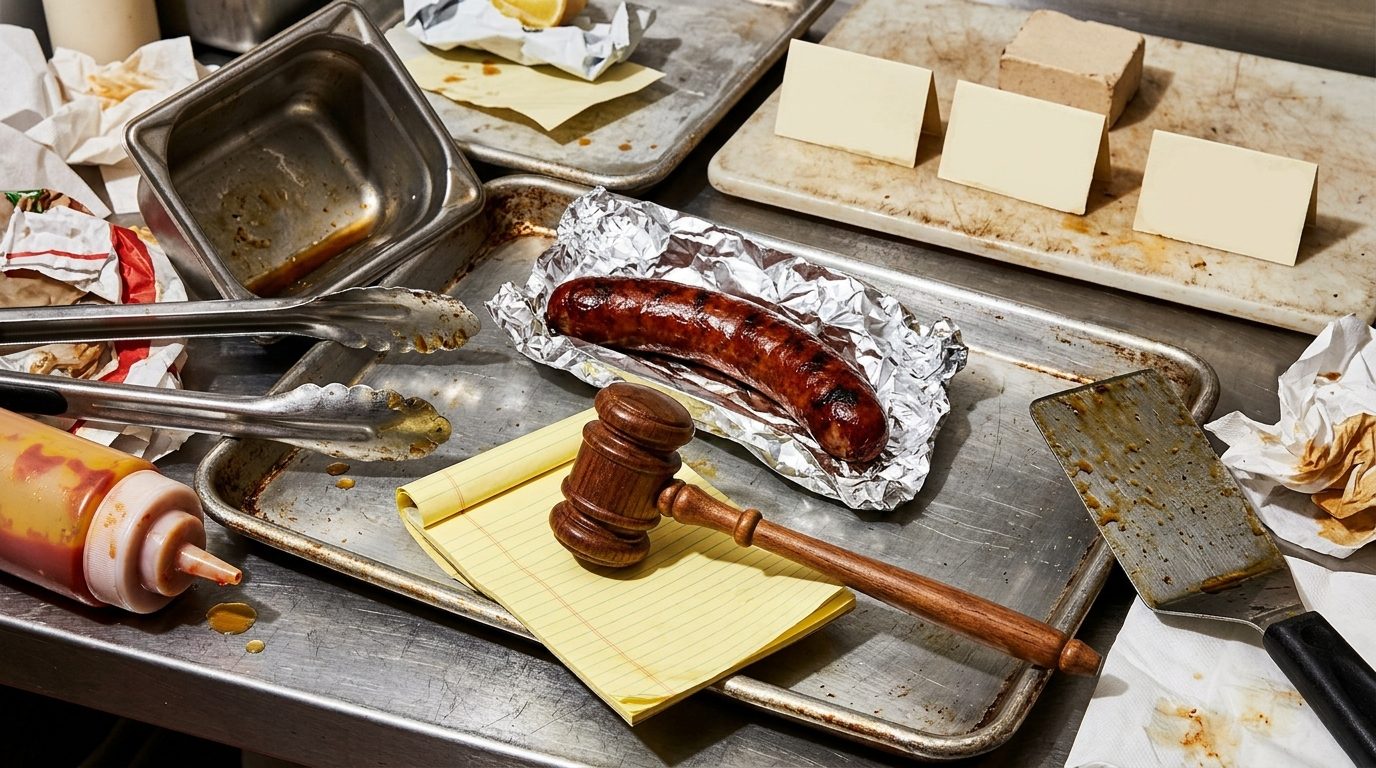
For hot dog fans, Costco regulars, and anyone who treats a food-court receipt like an archaeological document, the honest answer is this: Costco’s Polish dog deserves its legend, but not every detail attached to that legend deserves a sworn affidavit. It can be culturally important without every claimed date, recipe detail, price, or nationwide availability story being settled fact. The sausage is on trial. Memory is the star witness. Memory is also wearing a suspiciously theatrical hat.
Was Costco’s Polish Dog Really Lost, or Did the Internet Put Nostalgia on Trial?
This is not a product obituary pretending to know more than it knows. It is an investigation into the Polish dog’s place in Costco food-court history, with a firm rule: an online recollection is not automatically documentation just because it has 4,000 likes and the phrase “I remember this vividly.”
A remembered menu item can matter enormously even when people disagree about its exact timeline, ingredients, price, or where it was sold. That is the central tension. One person recalls a regular stop after a bulk-shopping run. Another remembers a more heavily seasoned alternative to the standard dog. A third announces a precise removal story with the certainty of a person who has never met a footnote.
All three may be describing something real. They are not necessarily describing the same thing, from the same warehouse, in the same year, or from the same menu.
Exhibit A: What Costco’s Menu History Can Actually Prove
Costco has sold hot dogs as part of its food-court identity, and the Polish dog has long occupied a place in customer discussion around that menu. Beyond that broad point, responsible history gets more granular and less glamorous very quickly.
To establish a particular claim, such as an introduction date, a removal date, a recipe change, a price, or a specific warehouse’s menu, the evidence should be tied to a reliable and dated source. That could include an official Costco menu or announcement, a contemporaneous report that identifies its source, or archived material with a clear location and date.
Without that evidence in hand, this article will not declare one universal national timeline. Costco locations can have market-specific menus. A change observed at one warehouse may be a local variation, a temporary supply issue, or a menu decision that did not apply everywhere. A customer’s personal food-court history is valuable evidence of that customer’s experience. It is not, by itself, a map of every Costco food court.
What counts as proof, and what merely starts the hunt?
| Type of claim | Best treated as | What would strengthen it |
|---|---|---|
| A dated official menu lists a Polish dog at a named location | Documented menu evidence | Matching official or contemporaneous material from other locations |
| A shopper says a Polish dog disappeared from their warehouse | Personal recollection | A dated photo, receipt, local reporting, or official menu record |
| A social post states an exact nationwide change date | A lead, not proof | A traceable primary source or reliable reporting |
| A forum thread describes a recipe difference | Customer impression | Ingredient or supplier documentation tied to a location and period |
Internet screenshots, message-board posts, comment threads, and old photos are useful. They can point researchers toward a date, a city, or a menu board worth checking. They do not become self-verifying because the comments are loud enough to rattle the soda fountain.
The Polish Dog Was Never Just Another Tube of Meat
People did not build a legend around a spreadsheet. They built it around a ritual.
The Costco food court sits at the end of an errand defined by giant carts, industrial quantities, and the strange confidence of buying enough paper towels to survive a minor siege. A hot dog stop can turn that mission into an occasion. It is fast, familiar, and comparatively affordable in a setting where nearly everything else is sold by the pallet.
For customers who preferred the Polish dog, it appears to have represented a distinct choice within that ritual. Some remember a different seasoning profile, texture, size, or overall personality from Costco’s standard hot dog. Those impressions are worth hearing, but they should remain impressions unless they can be tied to documented ingredient or product information.
Why can an inexpensive menu item inspire attachment that pricier restaurant dishes never earn? Repetition helps. Accessibility helps. Habit helps. So does the small private thrill of feeling that you found a deal the universe forgot to ruin. A birthday tasting menu may be more elaborate. The dog after a warehouse run may be more reliably yours.
Jason’s Memory Enters the Courtroom, and It Has Mustard on Its Tie
Jason brings ten years, 50 states, and zero ketchup to the bench. That is meaningful experience in the study of hot dogs, especially when the question is what people value in a sausage, a bun, a topping strategy, or a regional ritual. It does not magically establish a specific Costco recipe, calendar date, or warehouse policy. No honest hot dog obsessive gets to cross-examine history with vibes alone.
That distinction matters because sensory memory is persuasive. A person may remember the snap, the seasoning, the bun, the topping arrangement, the portion, the price, or the fluorescent majesty of the food-court table. Those details can be emotionally precise while still being factually incomplete. The mind is excellent at saving the feeling. It is less dependable at filing exact dates and ingredient panels.
Perfect nostalgia should make us suspicious. It tends to polish every sausage until it glows like a tiny meat lighthouse. A better approach is to say: this is what I remember, this is what the record can support, and this is the gap where a good story may have taken over.
Costco’s Polish Dog Versus Costco Folklore
Here is the sorting table. It is not anti-nostalgia. It is pro-nostalgia with a clipboard.
Bucket one: Confirmed history
- A claim supported by a dated official menu, statement, or other reliable contemporaneous record.
- A location-specific menu change that is documented for that place and time.
- A verifiable product fact that can be connected to a source rather than a comment section.
Bucket two: Plausible but unverified recollection
- A shopper’s account of seeing or ordering the item at a named warehouse.
- A remembered difference in flavor, snap, size, bun, or toppings.
- A locally observed menu transition without documentation that establishes a broader pattern.
Bucket three: Internet folklore
- A sweeping nationwide claim with no traceable evidence.
- A precise explanation for a menu change that circulates without an attributable source.
- A recipe claim repeated across posts that all appear to be repeating one earlier memory.
- Any statement that turns “my Costco did this” into “every Costco did this.”
Repeated claims can acquire a fake patina of authority. One person posts a memory. Ten people repeat it. A hundred people reply that they always heard the same thing. Soon the story is dressed in a judge’s robe and asking for a gavel. Food myths are delightful, but volume is not verification.
Why the Disappearance Feels Personal, Even When the Receipt Was Tiny
Menu nostalgia is rarely just hunger with better lighting. People mourn routines: the shopping trip with a parent, the post-game stop, the predictable lunch, the shared table, the pleasure of finishing an errand with something warm and salty. When an everyday favorite changes or vanishes, the loss can feel oddly intimate because it removes a tiny reliable pleasure from a familiar sequence.
That is especially potent with accessible food. A rare luxury can feel distant by design. A food-court favorite feels woven into ordinary life. You did not need a reservation, a special occasion, or a heroic credit limit. You needed a cart, an appetite, and the willingness to leave with more snacks than your trunk could emotionally process.
Not everyone loved the Polish dog, and there is no reason to pretend otherwise. Still, the intensity around it suggests that the argument is not only about sausage. It is about whether a place people knew by repetition stayed recognizably theirs. The real object of mourning may be the dog, the ritual, or a remembered version of Costco that has become impossible to revisit except through a comment thread full of capital letters.
The Verdict: Cultural Artifact, Imperfect Evidence, Excellent Argument
Costco’s Polish dog should be treated as a genuine food-culture artifact, not as a blank screen for every unverified tale that wanders in holding a napkin. Documented facts deserve confidence. Personal memories deserve respect. Folklore deserves a raised eyebrow, then one more question.
My verdict: the Polish dog’s afterlife may say less about a single menu item than about how fiercely people defend small pleasures that once felt reliably theirs. That is not silly. It is human. Also, it is exactly why hot dog arguments can become more emotionally charged than several municipal elections.
For more hot dog arguments, places, products, and recipes, follow @jasonsgrub on Instagram.
FAQ: Five Questions Still Haunting the Costco Food Court
Was Costco’s Polish dog available at every warehouse?
Do not assume that it was. Food-court menus can vary by market and change over time. The safest approach is to identify the warehouse and the period in question, then look for a dated menu, official source, or reliable local reporting.
When did Costco remove or change the Polish dog?
A single removal or change date should only be stated when it is supported by reliable documentation for the relevant market. If sources conflict, or if they describe different locations, the honest answer is that the timeline is disputed rather than conveniently settled by folklore.
Was the Polish dog different from Costco’s regular hot dog?
Customers often describe it as distinct, particularly in seasoning, texture, or overall flavor. Those are useful impressions, not confirmed recipe specifications. Any claim about ingredients, size, preparation, or supplier should be supported by documentation tied to the relevant time and location.
Why do people remember the Polish dog so intensely?
Probably because it was part of a repeated, affordable ritual. It represented a familiar reward at the end of a bulk-shopping trip, and losing an everyday favorite can feel more personal than losing a once-a-year indulgence. That is cultural interpretation, not a measured scientific finding.
Can I still buy Costco’s Polish dog?
Do not rely on an old post or a stranger’s photo from another market. Check your local warehouse’s current food-court menu or a current Costco source. Availability can depend on location, and menu memory is not a live inventory system.
Enjoyed this? There's more from Jason's Grub.
Follow on Instagram →