Switzerland's Cervelat Crisis Started With a Sausage Skin
Switzerland’s cervelat crisis began with a casing shortage, not because the country forgot how to make sausage. For hot dog obsessives and food culture readers, it is a tidy lesson in how a humble skin can carry texture, shape, fireproof nerve, and a startling amount of national feeling.
- Traditional cervelat relied on natural beef casings, with Brazilian zebu cattle intestines valued for their size and elasticity.
- European food safety controls related to bovine spongiform encephalopathy disrupted access to those casings.
- A casing is not decorative wrapping. It affects the sausage’s diameter, bite, appearance, and behavior over heat.
- Zurich can give cervelat a local identity through the setting and preparation, even when no separate citywide sausage recipe is established.
- Jason’s verdict: a changed skin can still be authentic, provided the sausage keeps its essential flavor, texture, grilling manners, and social job.
The sausage skin that caused a national headache
The mystery is simple: Switzerland did not lose the idea of cervelat, it risked losing the casing that helped make the familiar sausage feel like itself. Cervelat is a Swiss sausage with a finely textured meat filling, commonly heated in water or cooked over a grill before it is eaten.
The casing does real work. It contains the filling, helps the sausage keep its rounded form, tolerates cooking heat, and contributes to the resistance a eater feels before the filling yields. A sausage without the right casing can still be edible. That is not the same thing as behaving like the sausage people expect at a fire.
This was a supply and food regulation problem, not a story of cervelat vanishing from every Swiss plate. The pressure point was access to a particular kind of natural casing that producers had long considered especially suitable.
Why Brazilian cattle intestines became so important
Brazilian zebu cattle intestines had been an important source of cervelat casings because their dimensions and elasticity suited the sausage. Swiss reporting on the episode describes the dependence clearly: the sought after casing was not merely any tube shaped edible material, but a natural beef casing with useful physical properties for this particular sausage.
European controls connected with bovine spongiform encephalopathy restricted imports of bovine intestines from Brazil, disrupting that established supply route. Switzerland’s food rules were closely connected to European requirements, so the problem reached Swiss sausage makers as well. That history is a trade and regulation story, not evidence that every replacement casing automatically made a bad cervelat.
There is an important distinction worth keeping intact. The confirmed problem was access to a casing that matched the traditional specification. Whether another casing was pleasing is a question of material, recipe, cooking, and personal taste. Sausage arguments become nonsense the moment they pretend those are all the same question.
What changes when the casing changes
A different casing can change the way cervelat looks, bites, and responds to heat, even when the filling stays similar. The most obvious changes are often physical rather than dramatic changes in flavor.
Natural casing versus manufactured casing
A natural casing is made from cleaned animal intestine. The United States Department of Agriculture explains that manufactured casings can include collagen products, while natural casings come from the gastrointestinal tract of food animals. Those are different materials with different handling properties, so they should not be treated as interchangeable by default.
What to watch over the fire
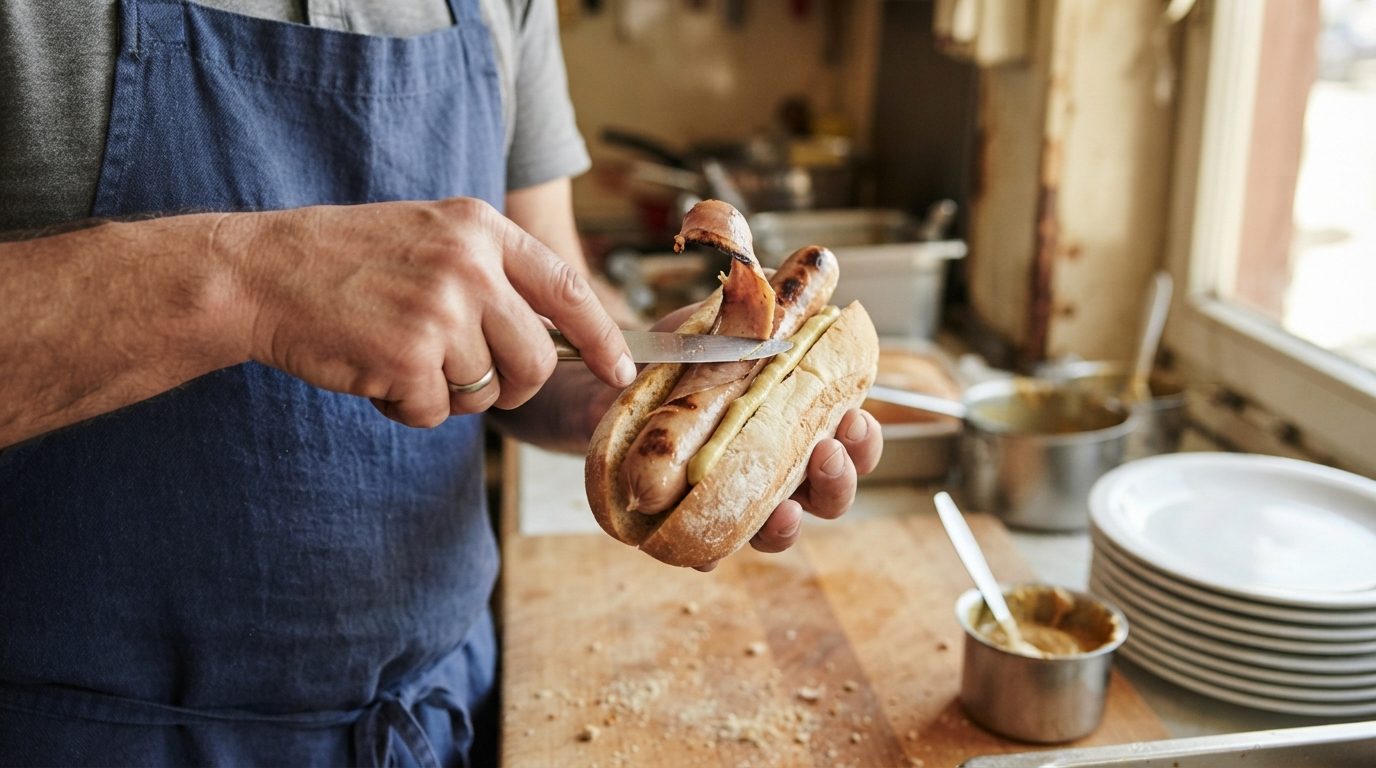
Look closely and the differences become less abstract. A natural casing may show a subtly irregular surface and can tighten around the filling as it heats. The cut ends, the way the sausage rounds out, and the point where it splits all help tell the story. A manufactured alternative may deliver a more uniform appearance or a different level of resistance. Neither observation is a universal flavor verdict.
For a grill cook, the practical questions are wonderfully blunt. Does the sausage stay intact? Does it brown without turning rubbery? Does it split in a controlled, appetizing way instead of surrendering its filling to the coals? That is where a tiny skin stops being a technicality.
Zurich’s cervelat is not just a passport with mustard
Zurich gives cervelat meaning through place and occasion, especially the Swiss habit of cooking it over an open fire, rather than through a reliably documented separate citywide formula. Swiss culinary references present cervelat as a grilling sausage and commonly pair it with bread and mustard.
That matters because “Zurich style” can be an overconfident label. A sausage served by the water, at a picnic, or from a grill in Zurich can be deeply local in experience without proving that every shop and every household follows one fixed preparation. If a menu claims an authentic Zurich cervelat, ask what exactly it means: the sausage maker, the cooking method, the accompaniment, or simply the address.
Place based identity and ingredient identity overlap, but they are not twins. The casing supply may change while the public ritual remains recognizable: a plump sausage, heat from a grill or fire, bread, mustard if desired, and absolutely no need for ketchup to barge in wearing a tiny fake moustache.
Can a cervelat stay authentic after the skin changes
Yes, a cervelat can remain authentic after a casing change if it still preserves the qualities that make the sausage recognizable in use and in culture. Authenticity is not just an ingredient list preserved under glass. It includes flavor, texture, shape, cooking behavior, and the shared expectation of what belongs over the fire.
Jason’s opinion: changing the casing does not automatically exile a sausage from its own tradition. If the new skin protects the filling, delivers the intended bite, handles grilling properly, and leaves the eating ritual intact, the tradition has adapted rather than evaporated.
There is a limit. If a substitute makes the sausage look, cook, or eat so differently that the familiar experience disappears, calling it the same tradition becomes harder to defend. No ketchup is not the measure of civilization, obviously. But a cervelat that cannot do cervelat things has a much larger identity problem than a missing condiment.
What readers should look for on the plate
A good practical read of cervelat starts with texture and cooking, not grand claims printed on a sign. You do not need laboratory equipment, a white coat, or a sausage séance.
- Look for a taut casing that holds the filling neatly rather than hanging loose or turning papery.
- Take note of the bite. It should feel deliberate, with casing and filling working together rather than fighting for custody of your molars.
- Check that the center is properly heated and that the outside has handled the grill without becoming tough.
- Notice how it splits after heating. A neat opening can be part of the appeal, while chaotic rupture usually suggests a cooking or casing mismatch.
- Treat claims of an “authentic Zurich cervelat” cautiously unless the seller explains the sausage, preparation, and local connection with some specificity.
Comparisons are useful only when the products and places are actually identifiable. Put two verified preparations side by side, cook them in comparable ways, and describe what your own teeth can confirm. That is better than inventing a mythology around a mystery sausage.
The casing crisis still tells the real story
The cervelat crisis showed that a small supply chain component can hold an enormous amount of cultural weight. The skin affected a familiar object’s material identity, and that made regulatory change feel personal at the grill.
Cervelat’s authenticity lives partly in material details and partly in the habits around it. The recipe matters. The casing matters. So does the moment when somebody cuts or heats the sausage and expects it to behave like a cervelat, not a generic tube having a difficult afternoon.
Jason’s verdict: “The skin may change, but the sausage still has to earn its place over the fire.”
A hot dog obsessive’s field note
Want more sausage leads without the beige food blog energy? Follow @jasonsgrub on Instagram for future hot dog place finds, recipes, products, and food culture coverage.
Cervelat questions that refuse to stay in the bun
These are the practical follow ups behind the casing drama.
What is cervelat?
Cervelat is a Swiss sausage traditionally made with a finely textured meat filling and a casing suited to cooking or grilling. It is commonly associated with grilling and open fire cooking.
Why did the casing become a crisis?
Traditional casings depended heavily on a supply affected by food safety restrictions and import disruption. Producers therefore had to find or assess substitute casings that could do the same physical job.
Does a different casing change the taste?
It can change texture, bite, appearance, and cooking behavior. The degree of flavor change depends on the specific substitute, the filling, and the preparation, so there is no honest universal answer.
What makes a cervelat feel authentic?
Authenticity can include the recipe, casing, texture, cooking method, local setting, and habits around eating it. People may weigh those elements differently, which is why sausage authenticity arguments have such impressive stamina.
Is Zurich cervelat a separate sausage?
Not necessarily. Cervelat is a broader Swiss sausage, while a Zurich expression may come from its local setting, preparation, and serving context. A claim of a distinct Zurich version needs a clear, verifiable local source rather than a decorative label.
Sources
These sources provide background on the casing shortage, food safety context, and the terms used for sausage casings.
Enjoyed this? There's more from Jason's Grub.
Follow on Instagram →